


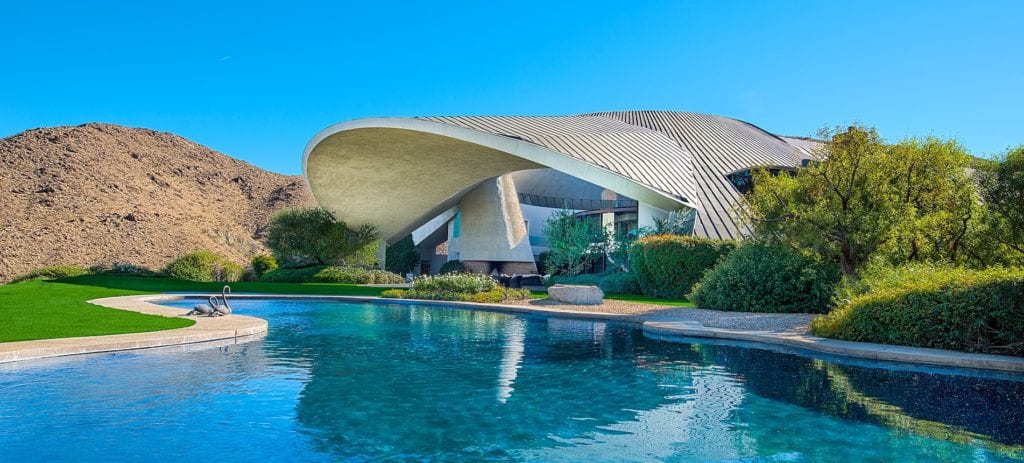
The influence of John Lautner, across Palm Springs, throughout the Coachella Valley, and even across the Southwest, is substantial and distinct. A master architect who rose to prominence ahead of and through the formative years for Palm Springs, Lautner left a truly unique imprint with his affection for organic modernism and his contribution to a wholly different aesthetic known as the Googie style.
He was a Frank Lloyd Wright disciple, working under him during a fellowship and, later, alongside him as a collaborator. Family commitments inspired him to begin his own architectural firm in Los Angeles and he relatively quickly made a name for himself with projects of significance.
Lautner’s career spanned commercial, public and residential commissions, and as he aged, his projects became all the more grand. While he has distinct architectural calling cards that identify the work as his, he also moved through his career in seasons — every so often veering into untouched territory.
His architectural influence across the Southwest began with a childhood rooted in creativity and design in Michigan.

Lautner’s Early Life
Raised in Northern Michigan, by a father who was an academic and a mother who was an interior designer and painter, Lautner took a somewhat unconventional path to his career in architecture.
His path from the Taliesin Fellowship to his own Los Angeles practice, and the turn toward organic modernism that followed, is covered in our article on the Bob Hope Estate.
Lautner’s Googie Style
The Googie style earned its name in the shadow of Googie’s Coffee Shop, a Sunset Boulevard joint Lautner designed in a way that would catch the attention of drivers cruising by. The post-WWII era is characterized with several booms, from housing to babies, and includes a keen interest in “car culture.”
The Googie style embraces a futuristic, if optimistic and playful aesthetic that focuses on turning heads. It is flashy and bright, incorporates neon lights and geometric shapes, and often integrates space age-themed elements.
While Googie’s is no longer standing, other Googie-style structures that Lautner designed remain. An octagonal Los Angeles home known as the Chemosphere sits on a pole above the treetops, making it appear as if a spaceship is floating above the city.
Likewise, the Elrod House in Palm Springs is perched above the city giving a flying saucer-type look if caught at the perfect angle. Its 60-foot concrete, circular canopy for a roof blends Lautner’s appreciation for organic immersion with his flair for futuristic design. The iconic home, which is designated as a Class 1 Historic Resource, was featured in the James Bond film Diamonds are Forever. The home is also listed on the National Register of Historic Places.
Lautner’s Grand Era
Lautner left his mark on several commercial projects while also developing a portfolio of residential work. His relationship with midcentury photographer Julius Shulman is noted as significant, as the two worked together for more than five decades. Shulman is said to have photographed 75 of Lautner’s projects. Lautner’s media presence was considerable, as he and his work were featured in national publications hundreds of times.
As Lautner aged, and his career progressed, the scope of his projects began to expand. One such commission involved a 25,000 square-foot residence in Acapulco, Mexico. Another involved an appointment as official Olympic Architect for the 1984 games in Los Angeles.
His commission for entertainer Bob Hope is less mentioned, but no less grand. The 23,366 square-foot Hope Estate was built by Lautner in the exclusive Southridge community of Palm Springs. The home is sometimes compared to a spaceship or volcano, for its space age roofline and its circular opening, allowing natural light to drench the interior.
The John Lautner Signature
In modern terms, Lautner may be considered a cross-over artist. His academic training is rooted in organic modernism while his career led him down paths that enmeshed his designs with futuristic and space-influenced designs.
Despite that crossover, there are several design elements that Lautner embraced and are therefore recognizable or attributable to his unique style of architecture.
- Homes shaped by their specific landscapes. Lautner was one to build into a landscape rather than on top of it.
- Utilizing concrete and steel. Lautner had a flair for designs that required advanced engineering, including shell-like rooflines, structures that appeared to float and bold concrete roofs and columns.
- Nearly seamless glass. Lautner used expansive glass walls to integrate a home’s placement within its landscape, creating a nearly invisible barrier between the interior and exterior and maximizing view corridors.
- Space age elements. As a pioneer of the Googie style, Lautner regularly utilized space-themed elements, including saucer and geometric shapes.
The PS Properties Connection
John Lautner designs are among our favorites at PS Properties. As real estate professionals who appreciate unique design and a pioneering spirit, we honestly marvel at the imprint Lautner left behind across Palm Springs and the Southwest.
It goes without saying that it is always an honor to work with residences that have an architectural significance. For us at PS Properties, that includes the Hope Estate, a residence we have represented off market.
While the Lautner-designed residence is not designated as a Class 1 Historic resource, it is no less significant. In fact, the Hope Estate is a stop — from afar — on driving and hiking architectural tours throughout Palm Springs. We understand the fascination.
Its unconventional roofline, its embrace of natural light, its impressive design and its general enormity make it a must-see for architecture buffs.
We honestly pride ourselves on our knowledge of and appreciation for the architectural greats who shaped Palm Springs and the Coachella Valley, and we believe it shows in the work we do for our clients. When we know that a historic property or one of architectural significance is being placed in our care, we take that responsibility seriously.
The PS Properties team recognizes the unique privilege it has to work in an area with such a rich history, while also working in a community that has a desire to preserve that history. We view our work in the industry as a piece of the preservation puzzle, doing our best to ensure that the area’s architectural treasures get the attention and respect they deserve.
With a Lautner property, we know we’re representing not just a residence, but architectural history.
Frequently Asked Questions
Who was John Lautner?
John Lautner rose to prominence as an architect during a formative period for Palm Springs and the greater Southwest, leaving his mark as someone who embraced organic modernism.
What is the Googie style, and how is John Lautner connected to it?
John Lautner is known for pioneering an architectural aesthetic known as the Googie style, so named after work he completed for an LA coffee shop with the same name. The futuristic and bold style was aimed at catching the attention of drivers as they rolled past roadside establishments.
Has PS Properties represented John Lautner homes?
PS Properties has represented homes designed by architect John Lautner, including the iconic Hope Estate, commissioned by legendary entertainer Bob Hope.
Which John Lautner house in Palm Springs is a Class 1 Historic Site?
The Arthur Elrod Residence at 2175 Southridge Drive. The City of Palm Springs designated it Class 1 Historic Site No. 64 on January 28, 2021 by Resolution 24851, and it was listed on the National Register of Historic Places in 2016. Lautner designed it in 1968 around a 60-foot circular concrete canopy, and it appeared in the James Bond film Diamonds Are Forever.
Where is the Hope Estate?
The Hope Estate stands on Southridge Drive in Palm Springs, on a ridge above the Coachella Valley and close to Lautner’s Elrod Residence. The PS Properties listing records the house at about 23,366 square feet on roughly six acres. PS Properties has represented the estate for the Hope Trust, and its 2016 announcement records the sale closing on November 10, 2016.
PS Properties, also known as Patrick Stewart Properties, has been serving the Palm Springs and Coachella Valley area for more than 20 years. Principals Patrick Jordan and Stewart Smith guide a team of experts who specialize in offering clients guidance when buying or selling distinctive modern, luxury, architecturally-significant or historically-significant homes. In a rare class of Palm Springs area realtors, PS Properties has been included in the $100 million club for three years running and has accrued more than $1 billion in real estate transactions. Learn more at https://www.patrickstewartproperties.com/.